 Doors · Chaukhat · Windows
Malaysian Sal Wood for Doors and Chaukhat: What to Check
“Malaysian sal” is a market name, not one fixed wood. Here is what it usually means, how it differs from desi sal, and what to check before you compare rates.

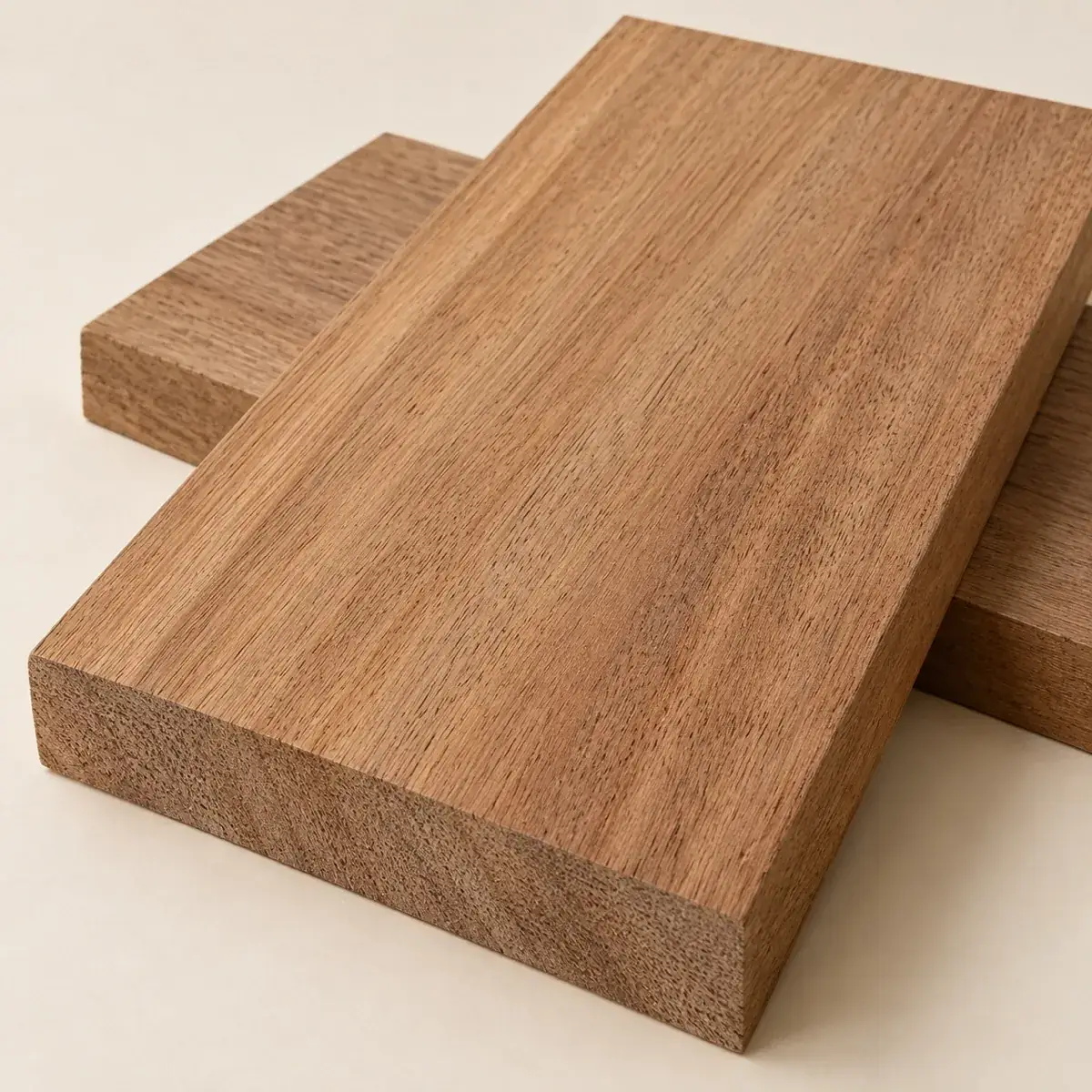
An illustrative hardwood sample. Confirm the species and the look of the wood you are actually supplied.
In short
- “Malaysian sal” is a trade name for imported wood. Indian forestry research links it to Meranti, for example the Yellow Meranti group.
- It is not the same as desi sal (sakhu, Shorea robusta), and kapur (“kapoor sal”) is a separate wood again.
- Get the timber group or species, origin, grade and finished sizes written on the quotation.
- Colour, weight or “old stock” claims prove nothing on their own. Check moisture, straightness and defects on the actual pieces.
When a quotation just says “Malaysian sal” (also written “Malaysian saal”), the most important question is still open: which wood are you actually buying. In the Indian market this name is used for imported hardwood sold under a broad trade label. It does not point to one wood with fixed properties.
So before you compare rates for a door, window or chaukhat, ask for the recognised timber group or the botanical (scientific) name. With that one detail, any talk about strength, life and value starts to make sense.
What “Malaysian sal” actually means
Indian forestry research has used the name “Malaysian sal” for imported Meranti timber. For example, a report by ICFRE (the Indian Council of Forestry Research and Education) places wood sold as “Golden Teak” or “Malaysian Sal” in the Yellow Meranti group. Malaysian timber references list separate groups such as Yellow Meranti, Light Red Meranti and Dark Red Meranti.
These group names tell you much more than a loose market name, although one group can still contain several species. Ask the supplier which group the stock on offer belongs to. A description copied from some other Meranti group is not good enough.
Is Malaysian sal the same as Indian sal?
Indian sal, also called sakhu or saakhu, is Shorea robusta. Don't assume that imported wood sold as Malaysian sal is the same species. Kapur, sometimes sold as “kapoor sal”, is another separate timber group. See our guides to desi sal (sakhu) and kapur.
The table shows what can fairly be said before the imported wood has been identified.
| Point | “Malaysian sal” in the market | Indian sal / sakhu |
|---|---|---|
| Botanical identity | Get the species or timber group confirmed | Shorea robusta |
| Where it comes from | Imported wood sold under a market name | South Asian wood |
| Proper trade name | The identified Meranti or other confirmed group | Sal / sakhu |
| Genus | Known only after proper identification | Shorea |
| Colour | Depends on the group and the surface | Paler sapwood; brown heartwood |
| Grain | Depends on the group; may be interlocked | Often interlocked |
| Texture | Depends on the group; Meranti is often moderately coarse | Medium to coarse |
| Density (weight) | Use the data for the identified group | Usually heavy; varies within the species |
| Strength | Group, grade and condition matter | Grade, grain and condition matter |
| Durability | Judge the identified wood and where it will be used | Treat heartwood and sapwood separately |
| Seasoning | Needs proper drying and conditioning | Needs careful drying and conditioning |
| Uses | Door and window work where the identified wood suits | Chaukhat and other suitable door and window work |
| How to identify | Papers; a specialist test if in doubt | Papers; a specialist test if in doubt |
Colour, grain and texture
There is no single Malaysian sal colour. Meranti groups can differ a lot. Yellow Meranti has a yellow-brown look, while the Red Meranti groups are pinkish to reddish-brown.
Look at a plain, freshly planed surface in daylight. A polished sample can make the colour look deeper and hide how an unpolished frame will really look. Interlocked grain (fibres that run in alternating directions) can give a nice pattern, but it needs care when planing and moulding.
Compare the actual pieces set aside for your order. Matching colour across the two leaves of a double door is a separate job from finding sound wood for a frame that will hardly be seen.
Weight and strength
One density or strength figure cannot describe everything sold as Malaysian sal. Technical data belong to a named timber group and the conditions it was tested in. They are not a guarantee for one particular plank.
For a door, the real questions are its weight, the quality of the joints, and how sound the wood is around the hinges and lock. For a chaukhat, what matters is long, straight pieces and sound spots for fixing. A heavy piece with a deep crack next to the hinge cut is a bad choice, however heavy it is.
Ask the maker to state the finished section size for your opening and the weight of the door it will carry. General carpentry advice is not a structural design.
Durability, deemak and outdoor use
Judge durability for the identified wood and where it will be used. Heartwood and sapwood can behave differently, and a door inside the house has a much easier life than one hit by rain again and again or touching a damp wall.
Don't trust blanket promises that Malaysian sal is termite-proof, rot-proof or maintenance-free. If you need protection, ask for a proper treatment and finishing spec, including what it cannot do. Polish on the surface is not proof of termite (deemak) protection.
For a window that faces the weather, the design matters too. Water must drain away, joints need protection, and the coating must be kept up. No wood can make up for a detail that keeps trapping water.
Seasoning and moisture
Wood takes in and gives out moisture as the air around it changes. If it is not properly dried when it is machined, it moves later, and door gaps, frame alignment and joints suffer.
Air drying and kiln drying are methods, not quality grades. Ask how the supplier checked the result:
- measured moisture readings
- how even the moisture is across the stock
- any drying defects
- how the wood was stored after drying
“Lying in stock for years” does not tell you its condition today. There is also no single moisture percentage for every building. The target depends on where the wood will be fitted and what it will become. A surface reading has to be read with the meter settings and the thickness of the wood in mind.
Where Malaysian sal can be used
Doors
Correctly identified, well-selected wood can be suitable for doors. Agree on the design, exposure and finish before you buy. Check the stiles and rails (the side and cross pieces of the door) for defects near joints, and make sure the construction leaves room for the panels to move.
For large or double doors, specify suitable hinges and how the two leaves meet. Simply scaling up a small door design changes its weight and the load on the frame.
Windows
Some Meranti groups are well-established woods for doors and windows, but an outside window still needs checking for that specific group. Look at the profiles, drainage, joints and coating together as one spec.
Chaukhat and frames
Focus on straightness, finished size, sound fixing areas and moisture. The rough-sawn size quoted is not the size left after planing, cutting the rebate (the step the door closes against) and removing defects. Get the finished width and depth in writing.
What to check before ordering
- Identity: the recognised timber group or botanical species, not just the name “Malaysian sal”.
- Source: the stated origin and the supplier's papers that back it up.
- Grade: how many knots, how much sapwood, and which splits and other defects are allowed.
- Condition: current moisture readings, drying method and storage.
- Straightness: look along the length for bow, crook, cup and twist.
- Surface and ends: look for cracks, insect holes, soft patches and signs of rot.
- Usable size: confirm the finished sizes, lengths and the expected machining loss.
- Product spec: agree on joints, hardware, finish and fitting.
Malaysian sal vs desi sal, teak and sheesham
Compare woods meant for the same product and the same exposure. The table gives buying points, not a ranking of which wood is “best”.
| Point | Malaysian sal | Indian sal | Teak | Sheesham |
|---|---|---|---|---|
| Identity | Confirm the group | Shorea robusta | Tectona grandis | Dalbergia sissoo |
| Density | Depends on the group | Usually heavy | Varies by stock | Varies by stock |
| Grain | Depends on the group | Often interlocked | Often straight; can vary | Can be irregular |
| Durability | Confirm the group | Judge the heartwood | Judge the heartwood | Judge the stock and use |
| Machining | Depends on the group | Hard; machine with care | Surface preparation for finish matters | Grain needs attention |
| Outdoor use | Confirm it suits | Design and protect | Design and protect | Judge the exposure |
| Price | Compare same grade | Compare same grade | Compare same grade | Compare same grade |
Price: compare the finished job
A low rate per CFT only helps when the wood's identity, grade and the way it is measured are clear. Ask whether the quote is for rough timber, machined sections or the finished product.
Add in seasoning, sorting, planing, waste, joinery, hardware, polish, delivery and fitting. Import and transport costs also move the price of Malaysian timber. Get a current quote for your actual spec instead of treating a rate you saw online as the fixed market price. Our guide to CFT and door pricing explains how these costs add up.
Our own Malaysian sal chaukhat is from ₹130 per running ft with a single rebate (4 × 2.5 to 5 × 2.5 inch sections) or from ₹160 with a double rebate (5 × 2.5 to 6 × 2.5 inch sections).
Source and certificates
Imported wood is not automatically certified or sustainably sourced. If someone claims certification, ask for the claim that covers this product and the supply-chain (chain of custody) papers. Malaysia has a timber certification scheme, but that does not make every Malaysian shipment certified.
Keep the bill and the written wood specification. If the agreed wood is changed for any reason, approve the change before the work starts.
Choosing the wood with NordWood
For a job in Lucknow, bring these to NordWood:
- the opening sizes
- a design reference or photo
- how much rain and sun the spot gets
A visit to our workshop in Daliganj lets you compare the actual timber, unpolished samples and how the joints are made before you decide.
NordWood offers on-site consultation, workshop visits and free fitting for doors and windows (chaukhat and window frame fitting on request, for a small charge). Use the quotation to record the wood, finished sizes, hardware and finish, so the finished work can be checked against the order. Call or WhatsApp +91 92358 06346, or reach us through the contact page.
Find out which wood is behind the name “Malaysian sal”, then plan the chaukhat around the door it will carry and where it will be fitted.
Malaysian sal chaukhat prices at NordWood
| Product | Price |
|---|---|
| Malaysian Sal Chaukhat (Door Frame) – Single Rebate4 × 2.5 to 5 × 2.5 inch sections | from ₹130 |
| Malaysian Sal Chaukhat (Frame) – Double Rebate5 × 2.5 to 6 × 2.5 inch sections | from ₹160 |
Prices from our current list. Other sizes are made to order. Chaukhat fitting is available on request for a small charge.
Questions people ask
Is Malaysian sal good for chaukhat?
It can be a good choice once the actual wood is identified and suits the frame. Sound sections, seasoning, sizes and fixing details all have to be checked together.
Is Malaysian sal better than Indian sal?
The market name is too broad to say. Compare the identified imported wood with the actual Shorea robusta stock, for the same product and the same grade.
Can I identify it by its colour?
Colour is worth noting, but it is not reliable proof of the species. Finishes, sun and weather, and differences within one timber group all change how it looks.
Is old stock always better?
No. Years in storage do not prove the right moisture, good seasoning or freedom from defects. Inspect and measure the wood as it is supplied.
Can it be used outdoors?
Only with the right timber spec and a design suited to the exposure. Confirm any treatment, coating and maintenance it will need.
What should my quotation call the wood?
The recognised timber group or botanical species next to the market name, plus the origin, grade and finished sizes where they apply.
Plan your doors and frames with us
See the wood at our workshop, get a clear price for your sizes, and free fitting for doors and windows.
Read next
Further reading
- ICFRE annual report 2006–07: imported “Golden teak (Malaysian sal)” placed in the Yellow Meranti group (archived copy)
- Malaysian Timber Council: Malaysian timber species, including the Meranti groups
- USDA Wood Handbook: drying wood and how it shrinks and swells
- Malaysian Timber Certification Council: timber certification and chain of custody