 Doors · Chaukhat · Windows
How to choose the right wood for doors, windows and chaukhat
Compare wood for doors, windows and chaukhats. What to check for seasoning, grain, frame sizes, finishing and fitting before you buy.

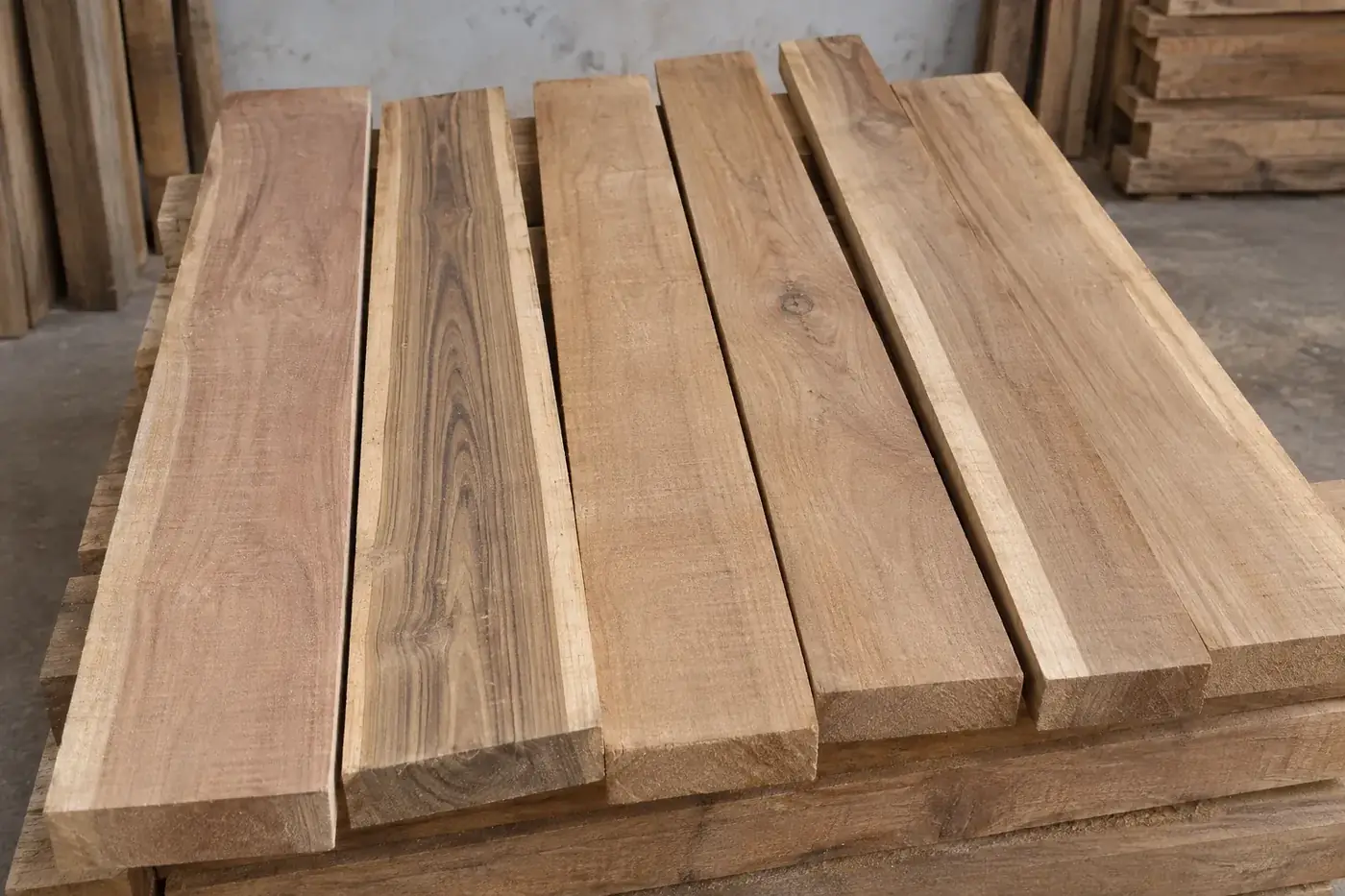
Plantation teak boards laid out for selection. Material reference: ask to see the wood for your order.
In short
- Start with where it will be fitted: rain, sun, humidity and AC change what you need.
- Plantation, imported and forest teak can be the same species. The name does not promise a grade.
- See the actual wood, and ask for moisture readings, not just the word "kiln-dried".
- Give the construction, the chaukhat and the finish the same attention as the wood.
- Compare complete quotations: sizes, hardware, finish, delivery and fitting, not only the rate.
A door that looks good in a showroom still has to live through Lucknow's hot summers, humid monsoon and years of daily use. So choosing wood starts with where the door or window will be fitted. After that, look at the condition of the actual timber and at how the whole piece is made.
For most homeowners, these four questions tell you more than a label like "premium teak":
- Will this door or window face rain or strong sun?
- Is the wood properly seasoned (dried)?
- What will the finished sizes be?
- Who will measure, fit and finish it?
This guide covers what to check when choosing wooden doors, windows and chaukhats, with Lucknow and similar North Indian weather in mind.
Start with where it will be fitted
A bedroom door inside the house and a west-facing main door need different planning. A window also has to drain rainwater and seal well around the opening. Before you talk about wood, tell the maker:
- Whether it will be indoors, under a porch or verandah, or open to rain.
- How much sun it gets.
- Whether the room is air-conditioned most of the time.
- The opening size, the door design and the hardware you plan (lock, handles, hinges).
- Whether you want a natural wood polish or paint.
A bathroom door may not get wet directly, but it still faces a lot of humidity. An outside window may need more care with drainage and coating than an inside door made from the same wood.
Know what the wood name really means
Teak (sagwan)
Real teak is Tectona grandis, called sagwan in India. People choose it for its looks, because it moves relatively little with the weather, and because its heartwood (the darker inner wood) is naturally durable. Plantation teak, imported teak and Indian forest teak can all be the same species. These names tell you where or how the tree grew. They do not promise a grade.
Sal or sakhu
Indian sal is Shorea robusta. It is a heavy, strong hardwood, often used for chaukhats and other hard-working parts. Its weight and the way it dries need attention, especially in thick sections. A heavy door also needs strong hinges, good fixings and a sound frame.
Kapur and "Malaysian sal"
These names need more care. Kapur is timber from the Dryobalanops group. "Malaysian sal" is a market name that does not point to one fixed species. Ask for the botanical name or the timber group before you compare durability or price.
The USDA Wood Handbook and ICFRE's field identification handbook (linked at the end) explain why the species, the grade and the condition of each piece have to be looked at together.
Which wood NordWood uses where
| Product | Woods we offer |
|---|---|
| Doors (single and double) | Plantation teak, forest teak (Nigam teak), imported teak |
| Chaukhat (door frames) | Kapoor sal (kapur), Malaysian sal, desi sal (sakhu) |
| Windows | Plantation teak |
| Window frames | Teak |
Each wood has its own guide: plantation teak, forest teak, imported teak, Malaysian sal, kapur and desi sal.
Words you will hear at the timber shop
Timber merchants, mistris and thekedars often use these words. Here is what each one means.
| Word | Meaning |
|---|---|
| Sagwan | Teak (Tectona grandis) |
| Sal, saal, sakhu | Indian sal (Shorea robusta) |
| Chaukhat | Door frame: the frame fixed in the wall that the door hangs on |
| Darwaza | Door |
| Khidki | Window |
| Jali | Mesh, as in a jali door that keeps mosquitoes out |
| Deemak | Termite |
| Nami | Moisture in the wood |
| Mistri | Carpenter |
| Thekedar | Contractor |
| CFT | Cubic feet: the amount of wood. See our guide to CFT and door pricing |
Ask to see the actual wood
A polished sample shows how the finish might look. It does not show the quality of the boards that will go into your order.
Where you can, look at the unpolished wood or samples from the same lot:
- Hold one end of a long piece near your eye and look along its length for a bend (bow) or a twist.
- Check the ends for deep cracks (splits).
- Look closely at the places where hinges, the lock and the joints will be cut.
- Small, tight knots can be fine in a design. Loose knots, or deep cracks near a joint, need a closer look.
Colour and smell give clues, but they do not prove which wood it is. Ask for the name of the wood and where it comes from, in writing.
You can see the wood at our Daliganj workshop before you order. Please call ahead to plan your visit.
Make seasoning something you can check
Wood takes in and gives out moisture (nami) from the air. If it is cut and shaped while still too wet for the place it will be used, it dries later, and the fit and joints can suffer. Wood dried for a much drier place can also move once it is fitted somewhere humid.
"Kiln-dried" tells you the drying method. It does not tell you the condition of each piece on the day of delivery. So ask:
- What are the current moisture readings?
- How were they taken?
- What target was agreed for your project?
The readings should take into account the meter used, the species and the thickness of the piece.
There is no one perfect moisture percentage for every door or window in India. BIS IS 287 gives moisture content recommendations for different uses and climates. The maker should choose a suitable target for your job, not promise that one number works everywhere.
Check how it is made, not only the wood
A wide solid wood panel needs some room to move as the humidity changes. The joints, panel layout, glue and hardware should suit the design and the place where the door will be fitted.
Ask the maker:
- How will the door allow for wood movement?
- What will the finished thickness be?
- How will the door be supported, that is, which hinges and fixings?
For a large door or a double door, talk about the leaf weight, hinges, locks, the edges where the two leaves meet and the frame, all together.
Solid wood, veneered doors, plywood-based doors and other engineered doors are different kinds of construction. Do not judge all engineered doors by ordinary MDF. How they handle moisture depends on the core, the glue, the grade and how the whole door is put together.
Give the chaukhat the same attention
The chaukhat carries the door and passes its load into the wall through its fixings. A well-made door cannot make up for a chaukhat that is too thin, twisted or badly fitted.
Before the work starts, confirm:
- The finished section size of the frame.
- The rebate, the step the door closes against.
- The wall thickness.
- How the frame will be fixed to the wall.
- The gap (clearance) left around the door.
"Rough size" and "finished size" are not the same thing. Planing and shaping remove wood, so the finished piece is smaller than the rough timber.
At fitting time, the opening should be ready, the frame should be checked for square and plumb (straight up), and the wood should be protected from constant moisture where it meets brickwork or the floor.
Decide who will do the polish or paint
NordWood supplies both polished and unpolished products. An unpolished door lets you choose the final look, but you still need a plan to finish it before it faces the weather and daily use.
- Ask for a finish sample on the actual wood. Clear polish, stain or paint can change the look a lot.
- Outside doors and windows need a proper exterior coating system, with care at the edges, end grain, joints and the cut-outs for hardware.
- Follow the coating maker's instructions for preparation and upkeep. Putting oil or wax over an existing finish is not always right.
Compare complete quotations
A lower wood rate does not always mean a cheaper finished door. When comparing quotes, check:
- The species or timber group, and the grade.
- Finished sizes and how it is made.
- Glass, hardware and other items included.
- Surface preparation and finishing (polish or paint).
- Measurement, delivery and fitting.
- The agreed delivery time, payment terms and after-sales support.
If timber is quoted by volume (CFT), make sure both quotes use the same unit and say whether the sizes are rough or finished. For a finished door, compare the full specification, not just the rate. Our note on CFT and door pricing explains this in more detail.
Choosing wood with NordWood
NordWood makes solid wood doors, windows and chaukhats for customers in Lucknow. Our family has been in the timber trade since the 1960s. With us you can:
- Ask for a site visit to discuss the opening and the design.
- Visit our workshop in Daliganj to see and compare the wood.
- Choose a polished or an unpolished finish.
- Get free fitting for doors and windows. Chaukhat and window frame fitting is available on request for a small charge.
Bring or send your drawings, rough opening sizes, photos and the style you like. That gives us a clear starting point to suggest a wood and prepare a useful quotation. Contact us or send the details on WhatsApp.
Start with where the door or window will be fitted and the actual wood, then agree the finished sizes, construction, seasoning and fitting.
Starting prices at NordWood
| Product | Price |
|---|---|
| Plantation Teak Single Door8 ready sizes, 7 ft and 8 ft high | from ₹14,350 |
| Desi Sal Chaukhat (Door Frame) – Double Rebate5 × 2.5 to 6 × 3 inch sections | from ₹260 |
| Plantation Teak Window4 × 3 ft or 5 × 3.5 ft | from ₹8,900 |
| Teak Window Frame Kit – Standard | ₹6,500 |
| Teak Window Frame Kit – Premium | ₹9,200 |
Prices from our current list. Other sizes are made to order. Fitting is free for doors and windows. Chaukhat and window frame fitting is available on request for a small charge.
Questions people ask
Which wood is best for a main door?
There is no single winner. Well-seasoned teak is a familiar choice, and other properly identified hardwoods can also work. Let the exposure to sun and rain, the heartwood, defects, construction, hardware and upkeep guide the choice.
Is teak termite-proof?
No. Teak heartwood has natural resistance to deemak, but sapwood and individual pieces differ. Good termite treatment for the building and keeping moisture away are still important.
Is sal good for a chaukhat?
Sound, properly seasoned sal can be a practical frame wood. Check that it is straight, free of deep cracks, of the right finished size, and sound around the joints and fixing points.
Should I choose kiln-dried wood?
Ask about the measured moisture condition, not only the drying label. Correct drying, conditioning and storage matter whichever method is used.
Can I polish an unpolished door later?
Yes, but agree how it will be stored and when it will be sealed. Do not leave an unfinished outside door exposed while other building work goes on.
Plan your doors and frames with us
See the wood at our workshop, get a clear price for your sizes, and free fitting for doors and windows.
Read next
Further reading
- USDA Forest Products Laboratory: Wood Handbook
- BIS: IS 287, moisture content recommendations for timber
- ICFRE: Field Identification of Selected Timbers of India (archived copy)