 Doors · Chaukhat · Windows
Forest and Nigam Teak Wood: A Buyer’s Guide for Doors and Frames
“Forest teak” and “Nigam teak” tell you about the source or the sale, not the quality. Here is what to ask about the lot, and how to check the wood before you order.

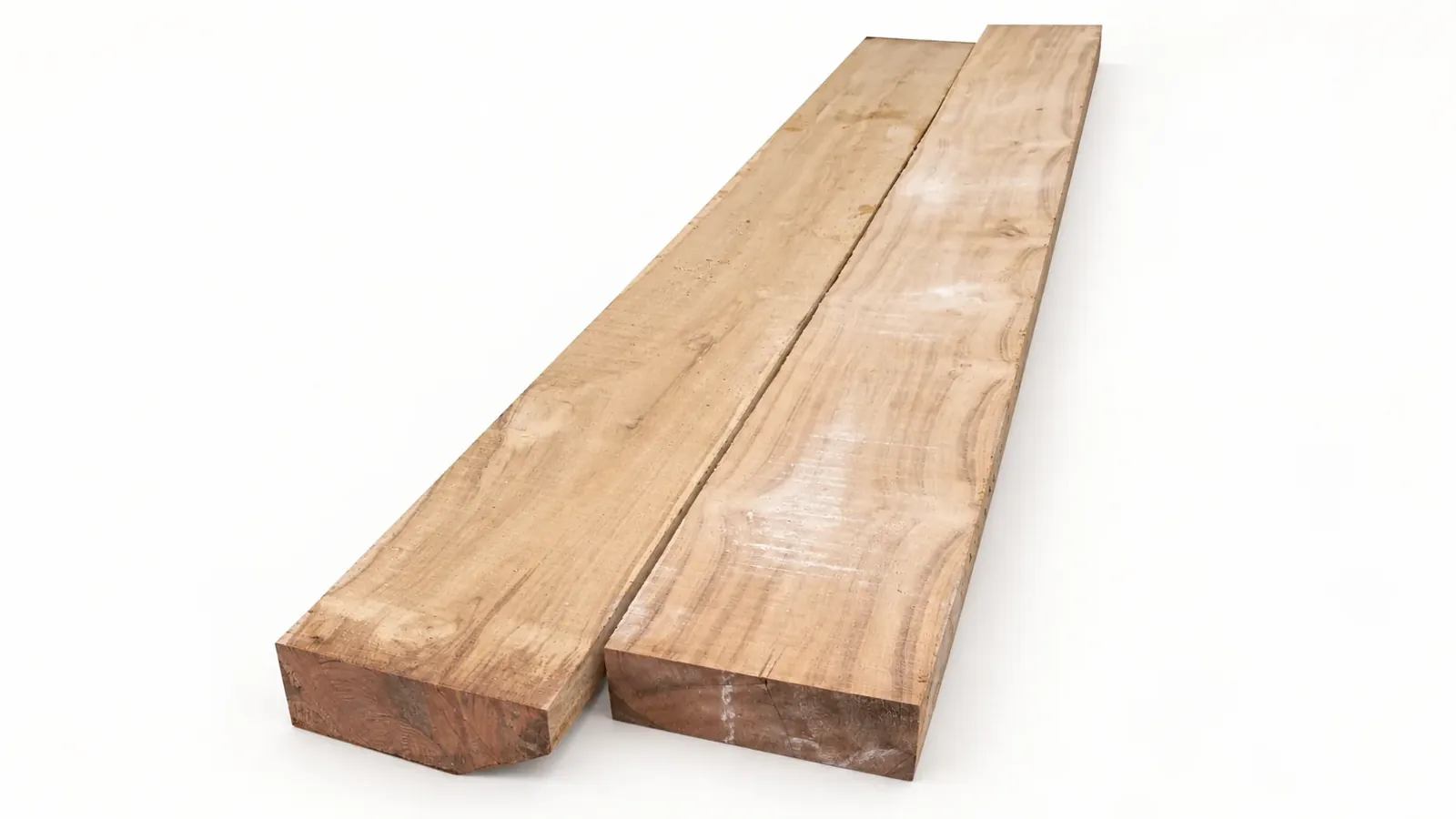
Sawn forest teak boards. Photos are for reference; compare with a sample from current stock.
In short
- “Forest teak” and “Nigam teak” describe where the wood grew or how it was sold. They do not prove tree age or grade.
- Ask for the papers of the lot, and read each paper only for what it actually proves.
- Check the wood itself: heartwood, straightness, defects, real finished sizes and measured moisture.
- Older teak, or teak stored for years, is not automatically better or ready to use.
- Compare full quotations, not just the rate per CFT.
When a timber seller calls a piece “forest teak” or “Nigam teak”, ask what that actually tells you about the wood. Is the source written down? Which lot did it come from? Is the piece sound, properly seasoned and right for the door you want?
Real teak is Tectona grandis, called sagwan in India. People choose it for its grain, because it is easy to work, because it moves fairly little with the weather, and because its heartwood lasts well naturally. That still does not make every teak log the same grade.
This guide explains what the names mean, and the checks that matter when you buy teak for doors, windows and chaukhats.
What “forest teak” and “Nigam teak” mean
Forest teak describes where the tree grew. On its own, it does not prove the tree’s age, any grade, or the condition of the wood.
Nigam teak usually means teak sold through a state forest corporation (van nigam). The Uttar Pradesh Forest Corporation publishes information about its timber sales and depots, and its auctions come with records for each lot.
Where wood was sold is not the same as how it grew. Teak sold by a corporation should not automatically be called old-growth or natural forest teak. Ask for the papers that belong to that lot.
What to ask about auction (Nigam) wood
Useful details include:
- species
- depot
- lot number
- sale or purchase record
- sizes and quantity
- any category or grade written on the record
Read each paper only for what it actually proves. A lot number helps trace the wood, but it says nothing about the moisture in your finished door. A size class does not tell you the tree’s age.
If the wood has changed hands after the auction, ask how the seller’s stock links back to that auction record. Do not judge the source from how a log looks, or from a photo of an auction yard.
Does UP or Uttarakhand teak mean good quality?
No. A state’s name is not a grade. The growing site, the individual tree, sawing, defects, drying and storage all change the wood that finally reaches the workshop.
Also keep two things apart: where the wood was sold and where the tree grew. A depot in Uttar Pradesh or Uttarakhand is useful supply information, but it does not prove where every lot grew.
For your door or chaukhat, the usable wood and its condition today tell you more than any “this region is the best” claim.
How to check the wood itself
Heartwood and sapwood
The darker inner heartwood usually lasts better naturally than the paler outer sapwood. Ask which parts will go into your order, especially in pieces that face sun and rain.
Sound heartwood is good, but do not accept a piece with deep splits or rot just because it is dark.
Grain and colour
Teak is usually golden-brown to brown, with straight or sometimes wavy grain. How the log was sawn and how the surface was prepared change the pattern you see.
Choose the boards that will show with the finished design in mind. Matching colour gives a calm look; a strongly patterned panel can stand out as a feature. Neither one proves the age or strength of the wood.
Defects and straightness
Check the full length of the door’s stiles (side members) and the frame pieces, not just the ends. Look for twist, bow, deep cracks, loose knots and damage near joints, hinges and locks.
A big log does not promise big clean pieces. How much sound wood is left after cutting out defects and machining is part of what you are paying for.
Is it really teak?
Colour, smell and an oily feel are useful clues, not proof. Ask for the species to be written on the quotation. If there is a dispute, a professional wood-identification service (such as the one at FRI, Dehradun) is far more reliable than a trick seen on social media.
Is older teak always better?
A mature tree may give bigger pieces and a different share of heartwood, but age is only one factor. Age does not remove defects or fix poor seasoning.
In the same way, wood that has been stored for years is not automatically ready to use. Whether it stayed dry and sound depends on how it was stored.
Ask whether an age claim is backed by papers. If it is not, decide on what you can check: grade, heartwood, sizes, defects and measured moisture.
Seasoning and moisture: what a sample cannot show
Teak still takes in and gives out moisture. It generally moves less than many woods, which lowers some risks, but a teak door still moves a little as the seasons change.
Ask for:
- current moisture readings taken across the wood you are buying
- the moisture level agreed for your order
- how the wood is stored after drying
Thick chaukhat sections need extra care, because a reading on the surface may not show what is happening in the core.
The Indian standard BIS IS 287 gives moisture recommendations by use and by climate. One single percentage is not right for every home, every outside door and every air-conditioned room.
Air drying and kiln drying are two ways of drying. What matters is the result: the right moisture level, drying defects (such as cracks or warping) within acceptable limits, and wood that has settled properly before it is made into a door.
Using forest teak in doors, windows and chaukhats
Main and inside doors
Selected teak suits panel, carved and other solid wood door designs. The board layout, the joints and the room left for movement must suit the opening. An outside door also needs a protective finish and proper weather details, so that rain runs off instead of collecting.
Windows
A wooden window works as one unit. The frame, shutters, glass, seals, hardware and the details that send water away all matter. Teak cannot make up for a sill or joint that holds water.
Frames and chaukhats
Confirm the finished section, the rebate, the clear opening and how it will be fixed. Check long pieces for straightness, and make sure the wood is sound where the hinges and lock will go.
Before fitting, ask how the faces touching the wall and the joint with the floor will be handled. This matters most while building work is still going on and the frame could get wet from fresh plaster or other wet materials.
How durable is teak?
Teak heartwood is known for resisting decay naturally. But “termite-proof”, “waterproof” and “maintenance-free” are not honest promises. Sapwood, wood quality and exposure all differ.
Good design and upkeep protect your money:
- do not let water collect on or around the wood
- keep an eye on exposed edges and joints
- follow the care instructions from the maker of the polish or coating
Teak, sal and sheesham: compare for your use
These are three different species. Use this table to start a discussion, not as a ranking or a promise about every board.
| Teak (sagwan) | Indian sal (sakhu) | Sheesham | |
|---|---|---|---|
| Botanical name | Tectona grandis | Shorea robusta | Dalbergia sissoo |
| Weight | Fairly heavy; varies | Usually heavy; varies | Quite heavy; varies |
| Grain | Often straight, sometimes wavy | Often interlocked (fibres cross each other) | Straight to interlocked, or patterned |
| Look | Golden-brown to brown | Brown, often darkens with time | Brown with contrasting patterns |
| Natural durability | Heartwood valued; sapwood differs | Heartwood valued; condition matters | Check the heartwood and exposure |
| Common uses | Doors, windows, frames, furniture | Frames, construction, door and window work | Furniture, door and window work |
| Check first | Grade, moisture and usable sizes | Seasoning, weight and sound pieces | Grade, grain and seasoning |
What decides forest teak price
Compare like with like. A rate per CFT tells you little unless you also know the grade, sizes, defects, moisture and how much usable wood you will actually get.
For a finished door, the quotation should also cover making, finish, hardware, delivery and fitting. This table shows why two teak quotes can be different:
| Factor | What to compare |
|---|---|
| Species | Written confirmation that it is real teak |
| Source | Papers that support the claimed origin |
| Grade or category | What the grade means, and the actual stock |
| Sizes | Finished usable sizes, not just rough sizes |
| Heartwood | How much there is, and where it goes in the product |
| Grain | How it looks, and whether it suits each part |
| Moisture | Current reading and the agreed target |
| Seasoning | How well it was dried, and how it was stored after |
| Defects | How much usable wood they leave |
| Age or maturity | Only with papers; not a grade on its own |
| Market | What is available now, and today’s quotation |
| Processing | Whether machining, joinery and finish are included |
For our own ready sizes, forest teak doors start at ₹20,050 for a single door and ₹23,520 for a double door set. Both are in the price list below.
To check a CFT figure yourself, see our guide to CFT and door pricing.
Buying forest teak doors and chaukhats from NordWood
For a custom door, window or chaukhat, start with the opening and how much sun and rain it gets. NordWood can talk you through the wood we have and the design, arrange a visit to your site, and show you wood samples when you come to our workshop.
Make sure the order states the agreed species, finished sizes, finish and what fitting is included. If forest corporation (Nigam) origin matters to you, ask about the supporting papers before you order.
Visit us at 500/143, Kutubpur, Daliganj, Lucknow, or call +91 92358 06346. You can also send your sizes on WhatsApp.
Let the documented wood you are shown and the finished door details decide your forest teak, not the name on the label.
Forest teak door prices at NordWood
| Product | Price |
|---|---|
| Forest Teak Single Door8 ready sizes, 7 ft and 8 ft high | from ₹20,050 |
| Forest Teak Double Door10 ready sizes, 7 ft and 8 ft high | from ₹23,520 |
| Forest Teak Chaukhat (Door Frame) – Single Rebate4 × 2.5 to 6 × 3 inch sections | from ₹299 |
| Forest Teak Chaukhat (Door Frame) – Double Rebate5 × 2.5 to 6 × 3 inch sections | from ₹369 |
| Forest Teak Jali Door8 ready sizes, 7 ft and 8 ft high | from ₹12,373 |
Prices from our current list. Other sizes are made to order. Fitting is free for doors. Chaukhat fitting is available on request for a small charge.
Questions people ask
Is Nigam teak a separate species?
No. “Nigam” tells you how the wood was sold or sourced; it is not a type of tree. Confirm that the wood is Tectona grandis.
Does Nigam teak mean an old tree?
No. The name does not tell you any fixed age. Ask what the records for that particular lot actually show.
Is forest teak always better than plantation teak?
No. Compare the actual grade, sizes, heartwood, defects and drying. Plantation or forest origin is no substitute for checking the quality.
Can grain or colour prove where teak came from?
No. Teak varies in look, and cutting and finishing change it further. Rely on papers and, if needed, professional wood identification.
Is auction wood ready to make a door?
Not necessarily. It still has to be sawn into sections, selected, dried and allowed to settle before it is made into a door.
What should I check before ordering a teak chaukhat?
Check the finished section size, straightness, sound wood at the joints and fixing points, the current moisture level and the installation details.
Plan your doors and frames with us
See the wood at our workshop, get a clear price for your sizes, and free fitting for doors and windows.
Read next
Further reading
- Uttar Pradesh Forest Corporation: official timber-sale information
- FAO: Teak, a global overview
- USDA Forest Products Laboratory: Wood Handbook
- BIS: IS 287 moisture-content recommendations
- FRI Dehradun: wood identification and timber testing services (archived copy)